What Viggle announced
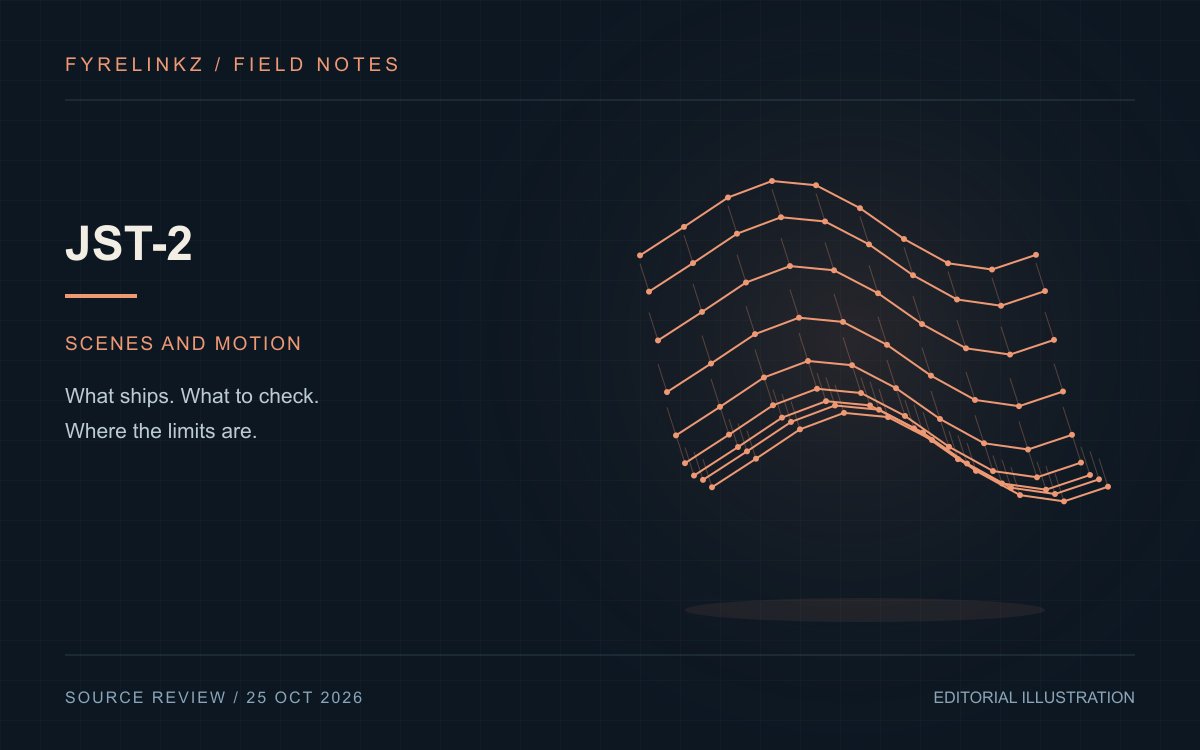
Viggle introduced JST-2 on October 19, 2026 for scene generation, animation-ready characters and full-body motion. Access is offered through its PINOC browser experience and API or MCP connections; the announcement does not establish a downloadable local checkpoint.
A 3D representation changes the workflow
Viggle says its decoder can produce images or 3D Gaussian splats, allowing repeated local browser viewing without regenerating the scene. New content still requires model inference. The useful question for a creator is therefore not simply whether a single frame looks good. It is whether the same space remains usable when the camera moves and when a character occupies it.
Read the speed claim with its boundary
The announcement reports scene inference in about one second on an NVIDIA B200, excluding network latency. That is not a promise of one-second end-to-end generation on a laptop. In a practical trial, time submission, service response, asset preparation and first interactive frame separately. A fast backend can still feel slow if a large asset takes time to download or render.
Test a small room before a large world
Our proposed test is a simple room with a doorway, a table and one distinctive object. Write down the intended layout before generation. Inspect the room from four camera positions and note duplicated objects, blocked passages and inconsistent scale. Then add a character and a short movement. Keep scene quality and motion quality as separate acceptance decisions, so a strong animation cannot hide a broken environment.
Physics-native does not mean all physics is learned
The project distinguishes learned character dynamics from rule-based scene collisions and object interactions. It places learned interaction dynamics on the JST-3 roadmap. For simulation work, inspect which component actually determines contact and movement rather than interpreting the product label as a guarantee of physical correctness.
An adoption checklist for creators
Before including a generated world in a client project, check export compatibility, service terms, attribution needs and whether you can reopen the asset outside the creation session. Keep source images that you have permission to use and retain the brief with the output. For motion work, review hands, foot contact and the character's route through the scene. FyreLinkz has not independently reproduced Viggle's timing or preference studies. Our video workflow comparison covers a different output decision: finished clips rather than persistent 3D worlds.
Frequently asked questions
Is JST-2 only a video generator?
No. Viggle describes a shared 3D representation for scenes, characters and motion, with outputs including images and Gaussian splats.
Does JST-2 learn every scene interaction?
No. The announcement says scene collisions and object interactions still use rule-based physics; learned interaction dynamics are part of the JST-3 roadmap.
Can I assume the one-second claim is laptop latency?
No. Viggle specifies B200 model inference and excludes network latency. Measure the complete hosted workflow separately.
Sources & further reading
Primary sources checked Oct 25, 2026. Vendor statements are attributed; editorial advice is our own.
- 1Introducing Viggle JST-2 ↗Viggle Research
Help us keep this useful. Report a factual correction →