What GaussiAnimate actually reports
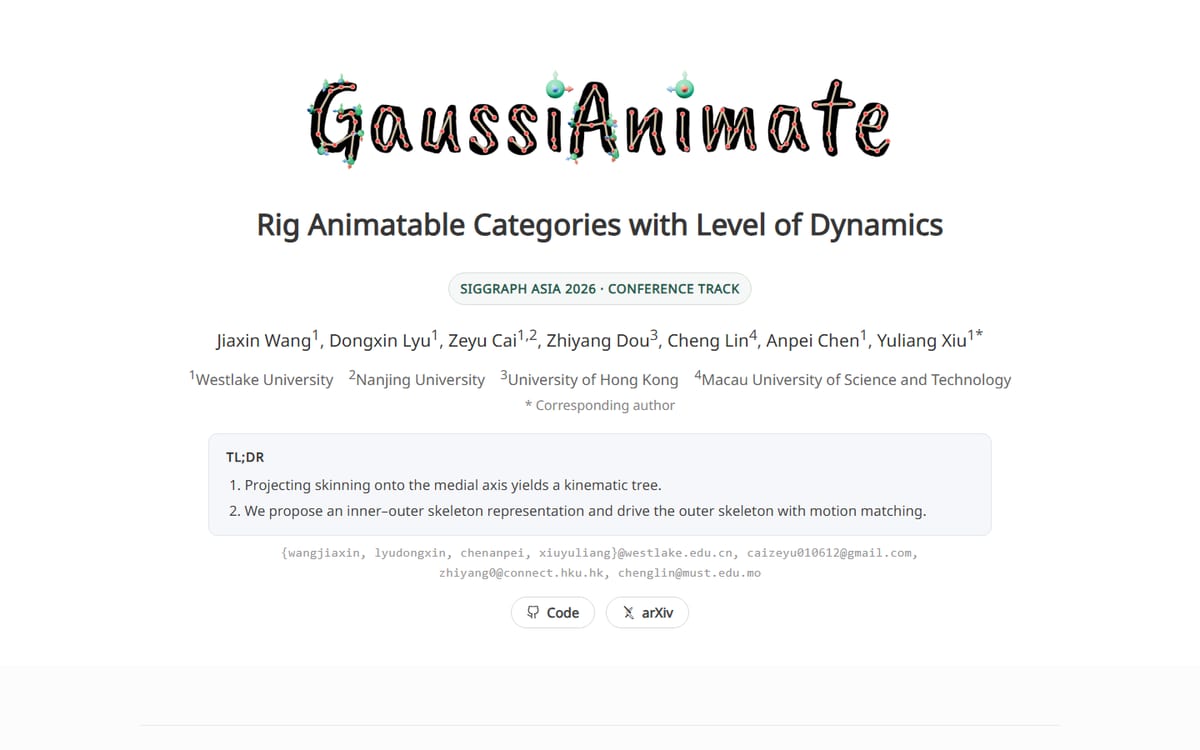
The authors describe skelebones: an inner kinematic structure coupled to free-form outer bones. Partwise Motion Matching retrieves and blends observed motion. Inputs include temporally consistent reconstructed Gaussian or mesh sequences, with examples covering clothed humans, animals and garments.
What this changes for the reader
For an animation team, the first question is what evidence the reconstruction contains. Loose cloth can move independently of the underlying limb, so matching a joint pose alone may not recover the expected surface motion. Our suggested review checks control usability and deformation together instead of judging a single attractive turntable.
Input readiness: what to inspect before rigging
Use the 3D asset review sheet to distinguish defects already present in a reconstruction from deformation introduced later. Choose a visible garment edge, a joint bend and one contact region. Track each through the same interval. If a feature flickers in the input, a clean still from the final animation is not enough to show the rig fixed it. This is an original review protocol rather than a measured claim about GaussiAnimate.
| Review gate | Check | Why separate it |
|---|---|---|
| Input sequence | Stable identity and temporal correspondence | Input defects can be mistaken for rig errors |
| Control motion | A known pose change and return | Makes the intended deformation inspectable |
| Surface behavior | Edges, folds and contacts over time | Joint alignment alone misses visible artifacts |
| Held-out interval | Motion not used in the comparison setup | Avoids evaluating only familiar frames |
A practical evaluation before adoption
Choose a sequence with a visible bend, an occlusion and a return to rest. Hold back part of the motion when evaluating a rig. Inspect joints, cloth silhouette and contact regions at equal playback speed, then review the controls an animator must use. Record preprocessing time separately from the final animation step.
- Confirm temporal consistency of the input reconstruction.
- Compare held-out poses and surface motion.
- Review code availability and research-use conditions.
Limits and availability to keep in view
The project reports its own comparisons. We have not run them, and its abstract's promise of code availability is not itself evidence that every asset or license is ready for production. Check the linked repository at the time of use.
Where this fits in a 3D workflow
UniForge3D concerns sparse-view shape completion, while PURE concerns reconstruction from observed video. GaussiAnimate assumes a consistent reconstructed moving sequence for its rigging problem. Keep these stages separate when deciding what you need to capture, reconstruct and review.
Frequently asked questions
Does GaussiAnimate start from an arbitrary single photo?
The project describes reconstructed consistent 4D Gaussian or mesh sequences as input.
What does Partwise Motion Matching do?
It uses observed motion to retrieve and blend part-level deformations for the rig.
Has FyreLinkz independently tested GaussiAnimate?
No. This article reports the linked primary source and proposes an editorial evaluation; it contains no independent performance benchmark.
Sources & further reading
Primary sources checked Oct 26, 2026. Vendor statements are attributed; editorial advice is our own.
- 1GaussiAnimate — primary source and release details ↗GaussiAnimate project
Help us keep this useful. Report a factual correction →