How much memory could Beam’s weights take?
A simple lower-bound estimate multiplies parameter count by bytes per weight. For 501 billion parameters, BF16 at two bytes per weight works out to about 1,002 GB (roughly 933 GiB) for the weights alone. FP8 at one byte is about 501 GB; four-bit storage at half a byte is about 251 GB before scales and metadata. These are arithmetic estimates, not a tested Beam build: the launch post does not document supported precisions or a tested serving configuration. Real inference also needs memory for the runtime, activations, cache and other buffers.
| Illustrative storage format | Raw weight estimate for 501B parameters | What this does—and does not—tell you |
|---|---|---|
| BF16 · 2 bytes/parameter | About 1,002 GB | A raw-weight lower bound; not a complete serving requirement. |
| FP8 · about 1 byte/parameter | About 501 GB | A hypothetical estimate; Beam’s supported format is not published. |
| 4-bit · about 0.5 byte/parameter | About 251 GB | A hypothetical estimate before quantization metadata and runtime memory. |
What Reflection announced
Reflection introduced Beam on October 5 as its first open-weight model, aimed at coding, reasoning and agentic workloads. The company describes a sparse mixture-of-experts (MoE) model with 501 billion total parameters and 23 billion active for each token. As of October 6, Reflection says selected users can request early access; it plans to publish the weights, model card, technical report and developer tools later this month under Apache 2.0. That launch-stage account did not establish final runtime requirements. Access information in this paragraph is the dated October 6 account; the benchmark discussion below was rechecked October 15. We have not independently confirmed a public checkpoint release.
Why 23B active does not mean a 23B model download
An MoE model routes each token through some of its expert networks rather than computing through every expert at once. This can lower the computation used for a token compared with a dense model of the same total size. The checkpoint still contains the experts: a 2025 ACL paper on MoE compression explains that fewer active parameters do not reduce total parameter count, and that expert weights create substantial memory pressure. Runtime strategies can shard weights across GPUs or offload them to system memory, but those choices need supported software and trade off speed, complexity or both.
Can one consumer GPU run Reflection Beam?
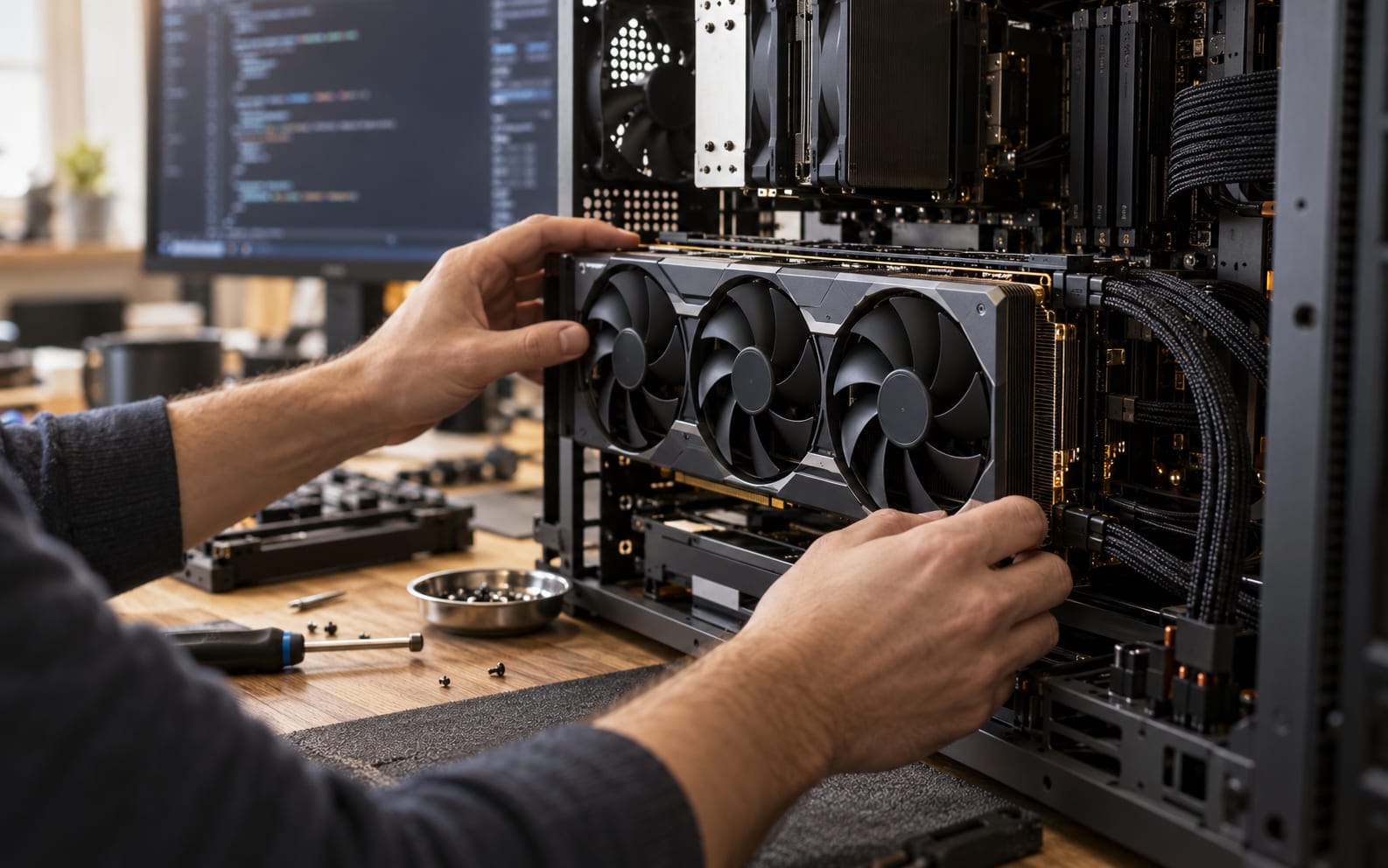
Not as a conventional, fully resident BF16 model on one card. NVIDIA lists 32 GB of memory for the GeForce RTX 5090 and 141 GB for the data-center H200; both are below even the rough 4-bit weight-only estimate above. A multi-GPU server, aggressive offload or a future compressed checkpoint could change the deployment options, but the launch post does not specify a supported inference configuration. The reported 6,144-GB300 pretraining cluster and 10,500-GPU reinforcement-learning run describe Reflection’s training work, not the hardware a user needs to serve Beam.
What do Beam’s benchmark numbers show?
Reflection marks its launch benchmark table as updated October 8. The current table reports Beam at 80.1 on Terminal-Bench v2.1. These are company-published results, not our independent evaluation. Its compute comparison excludes prompt prefill, context-dependent attention and serving overhead; it is not measured serving cost. Read the latest table and methodology directly before comparing models. This article's memory calculations are weight-only arithmetic, not benchmark results.
Beam GPU planning: what evidence would change the answer?
The arithmetic above is a capacity check, not proof of a runnable configuration. A supported compressed checkpoint could change the storage calculation; an active-parameter number alone cannot. Before planning an upgrade, follow the workstation purchase checklist and distinguish total weights from runtime memory in the VRAM guide.
- Find the exact public checkpoint and its license before treating an announcement as a download.
- Record its actual file sizes and supported precision instead of assuming a hypothetical 4-bit package exists.
- Find a supported runtime configuration, including hardware, context and concurrency.
- Require a reproducible loading result and measured peak memory before recommending a build.
- Keep hosted API costs separate from the cost of owning inference hardware.
What local AI builders should do now
Do not buy a GPU based on the 23B active number alone. Wait for Reflection’s checkpoint and model card, then check the actual quantized files, supported inference engines, memory measurements at your intended context length, license text and download source. If Beam is available only through a hosted endpoint at first, compare its live price and usage limits before planning a local build. For hardware choices you can make today, start with your actual workload and current software support in our AI workstation planner, and use our local LLM VRAM guide to understand the memory trade-offs.
Frequently asked questions
What is Reflection Beam?
Beam is Reflection’s announced open-weight language model for coding, reasoning and agentic tasks. Reflection describes it as a sparse mixture-of-experts model with 501 billion total parameters and 23 billion active per token.
Why does Beam have 501B total parameters but 23B active?
The model routes each token through a subset of its expert networks, so fewer parameters are used for that token’s computation. The total checkpoint still includes the experts, so active parameters do not equal the full model’s storage requirement.
Can I run Reflection Beam on an RTX 5090?
This article does not establish a supported RTX 5090 build. Its 32GB memory is below the hypothetical 251GB raw weight estimate at four bits, before metadata and runtime memory. Verify current model-card and runtime requirements.
Can I download Beam now?
The October 5 launch announcement offered early access and planned public weights later in October. This article has not independently confirmed current checkpoint distribution; check Reflection's official model and platform links.
Has Beam independently beaten Kimi K3 or Qwen 3.8 Max?
The October 5 announcement provides Reflection’s own benchmark table, not an independent evaluation. In its Terminal-Bench v2.1 row, Reflection lists Beam at 80.1, Kimi K3 at 88.3 and Qwen 3.8 Max at 86.6. Independent tests with published settings are still needed.
Does Reflection publish Beam API pricing?
The launch announcement does not list a public API price. Check Reflection’s current platform information when early access or public distribution opens.
Sources & further reading
Primary sources checked Oct 6, 2026. Vendor statements are attributed; editorial advice is our own.
- 1Introducing Beam: Reflection’s 501B open-weight model ↗Reflection · Oct 5, 2026
- 2EAC-MoE: Expert-Selection Aware Compressor for Mixture-of-Experts Large Language Models ↗Association for Computational Linguistics · Jul 27, 2025
- 3
- 4
Help us keep this useful. Report a factual correction →