Needle 3 vs Jev: the difference in one table
The useful distinction is deployment and output, not which model has the loudest launch claim. This is a documentation-based comparison; FyreLinkz has not executed a head-to-head benchmark. Confirm the exact runtime or API version before building around either.
| Decision | Needle 3 | TypeSafe Jev |
|---|---|---|
| Main job | Local tool calls, extraction and embeddings | Hosted typed decisions |
| Deployment | Supported on-device engine | TypeSafe API |
| Your own inference GPU | Not a universal discrete-GPU requirement | Not required for hosted calls |
| Price basis | Device/runtime resources; no token tariff on card | $0.042 per million input tokens; output free |
| Access/rights | Apache 2.0 model-card license; check dependencies | Hosted account and service terms |
| What still needs testing | Field and tool-call correctness on your device | Decision correctness on your exact task |
When Needle 3 is worth evaluating
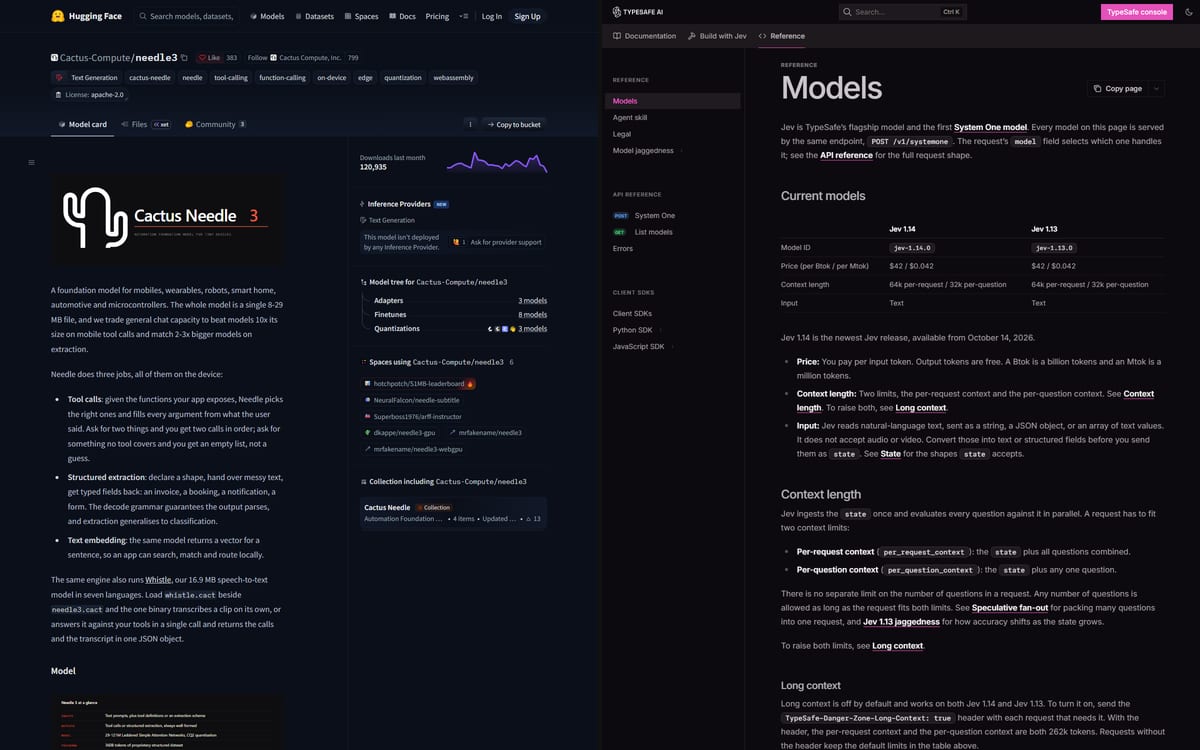
Cactus describes tool selection, schema-shaped extraction and embeddings running on the device. Its card lists Apache 2.0. That makes it a candidate for a local app workflow, rather than a general-purpose conversational model. Check the supported engine and exact artifact for your platform; model-file size is not total runtime memory. We do not infer a universal RAM requirement or speed from the card. Treat locally processed data as a system-design choice: surrounding app telemetry and connected tools can still transmit information.
When Jev fits: typed decisions through an API
TypeSafe's System One documentation describes decision outputs rather than generated prose. Its current model listing names jev-1.13.0 and accepts text input. You do not install a local Jev GPU checkpoint for these hosted calls. Define the decision you need, its allowed outputs and how your application handles a wrong result before choosing it. A typed result is an output-format property; it does not certify the underlying judgment.
Jev pricing: two worked input-token examples
TypeSafe lists $0.042 per million input tokens and no output-token charge. At that rate, 100 million input tokens cost $4.20. One million requests averaging 1,000 input tokens total one billion input tokens, or $42. These are arithmetic examples, not measured usage or an account quote; taxes and other operating costs are excluded. Log actual payload/token usage and recheck current pricing. Local inference has no provider token bill, but hardware, electricity, deployment and review effort remain separate costs.
Correct format is not the same as a correct answer
TypeSafe documents uneven Jev performance across tasks, including difficulties with numerical precision, counting and dates. Those limitations are a reason to test representative failures, not a universal rejection of the model. For either candidate, define correctness before running, retain mistaken outputs and test ambiguous or out-of-scope inputs. For consequential decisions, use review and escalation rather than treating a confidence value or valid schema as approval.
A small evaluation before a deployment decision
This is our proposed worksheet, not an executed benchmark. Give each system an appropriate version of the same underlying task; do not score a text-generating model, a tool router and a decision API as though they offer identical outputs.
- Write 30–100 representative cases, including ambiguity and requests outside the supported task.
- Record exact artifact/API version, input contract and expected fields or decisions.
- Separate output parsing from decision or extraction correctness.
- Log retries, latency, local peak memory where measurable and human correction time.
- Count actual hosted input tokens; keep local power and ownership costs separate.
- Keep failure examples and confirm behavior before automatically acting on outputs.
Needle or Jev? Decide from the output contract
Choose the task before comparing the deployment bill. A local tool router and a hosted decision service are not interchangeable simply because both can be small. If you need prose generation, first confirm that the selected product actually offers that output. For a wider cost comparison, use the local versus cloud cost worksheet.
| Requirement | Evaluation direction | Acceptance check |
|---|---|---|
| On-device extraction or tool selection | Evaluate Needle with its supported engine | Expected fields and correct tool choice |
| Typed decisions through a hosted API | Evaluate Jev against the decision contract | Correct permitted output, including ambiguous cases |
| General conversational writing | Recheck product fit before choosing either | Supported output type matches the application |
| Sensitive inputs | Review the complete application data path | Telemetry, connected tools and provider handling |
| Lowest operating cost | Compare accepted tasks rather than token price alone | Retries, correction time and actual usage |
Next: local memory checks or retrieval design
If local deployment is your goal, use our RTX 4050 memory guide to distinguish download size from runtime allocation. The hardware planner offers dated regional examples, not certification that Needle fits every device. For an embedding workflow, continue with the vector database comparison guide. Those are separate decisions from choosing a hosted decision API.
Frequently asked questions
What is the difference between Needle 3 and Jev?
Needle 3 is an on-device model for local tool calls, structured extraction and embeddings. Jev is TypeSafe's hosted typed-decision API. Compare the deployment and output contract needed by your application, then evaluate correctness.
Does Jev require my own GPU?
No for the documented hosted API. Your application sends text requests to TypeSafe; the provider runs inference. This is different from downloading and running a local model.
How much does Jev cost?
The model documentation checked October 11 lists $0.042 per million input tokens, with output tokens free. Rates and account conditions can change. Count actual input-token usage rather than treating request count as token count.
Can Needle 3 replace a general chatbot?
Its documented tasks are narrow structured work and embeddings. Do not assume those capabilities establish general conversational quality. Evaluate the exact outputs your app requires.
Which is more accurate, Needle 3 or Jev?
This article does not establish an accuracy winner. Their output contracts differ, and no FyreLinkz head-to-head test was run. Evaluate a representative task set and retain failures.
Sources & further reading
Primary sources checked Oct 11, 2026. Vendor statements are attributed; editorial advice is our own.
- 1Needle 3 model card, tasks and license ↗Cactus Compute — Hugging Face
- 2
- 3
- 4
Help us keep this useful. Report a factual correction →