What Ming 3.0 TTS offers
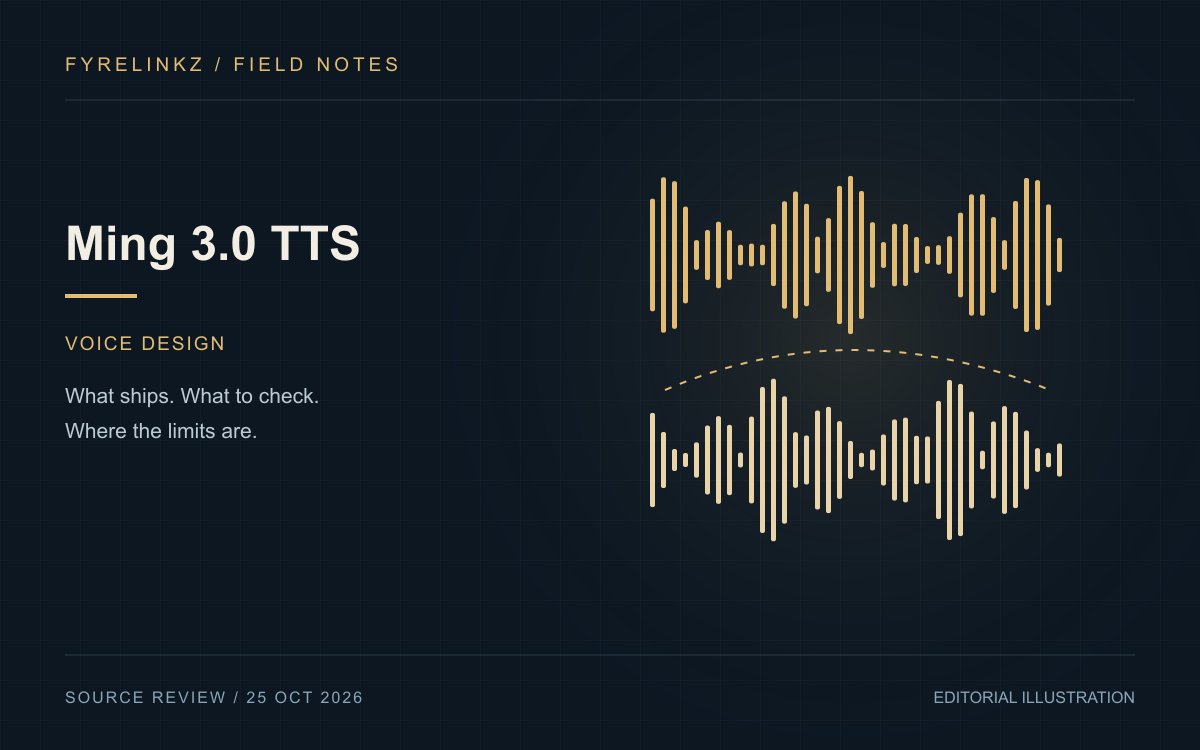
InclusionAI's release includes a 0.5B dense model and Tiny, a mixture-of-experts model with 7.9B total and 1.3B active parameters. The project supports voice design, cloning, free-form performance direction and paralinguistic tags. Tiny additionally supports multi-speaker podcast generation. The repository carries an MIT license and reports an October 2026 release.
Choose a task before writing a prompt
The cookbook separates cloning, multilingual generation, free-form direction, emotion, dialect and other controls. It explicitly rejects arbitrary combinations. Seven supported languages are Chinese, English, Japanese, Korean, French, German and Spanish; Cantonese and Sichuanese use their own dialect mode. This distinction matters more than a broad list of features when a production request fails.
A repeatable pronunciation test
Our suggested first evaluation uses an original forty-word script containing a date, a decimal, a name and a short abbreviation. Keep the text unchanged across three takes. Have a listener transcribe the clips without seeing your prompt, then compare the transcription with the intended script. Mark omissions and substitutions separately from accent preferences. A pleasant voice can still read a crucial number incorrectly. This is an evaluation plan, not a listening test we have completed.
Keep the two installation environments separate
The repository documents distinct dependency environments for 0.5B and Tiny and provides preflight tools that inspect checkpoints without loading their weights. Its reference hardware includes high-memory NVIDIA accelerators; those examples do not establish a consumer-GPU minimum. Start with the chosen model's documented environment rather than mixing dependencies from both variants.
Check permission, timing and editing effort
Use your own voice or a voice for which you have clear permission. Record the permitted purpose, reference recording and whether generated clips may be shared. For a narration job, measure the time spent correcting pronunciation, removing unwanted sounds and joining takes. Total production time includes those edits, not only inference. For short announcements, one misread unit may matter more than an overall naturalness score. Keep rejected clips so cost and effort are not understated.
When Ming belongs in a workflow
Pick one measurable goal: accurate product names, consistent character delivery or a permitted multilingual voice. Save the model revision, task, text and controls with the accepted audio. Do not infer that a model-size label predicts latency on your machine. Compare the same finished deliverable with our speech workflow guide, and keep transcription needs separate from speech generation.
Frequently asked questions
Does Ming 3.0 TTS Tiny mean 1.3B weights?
No. The project reports 7.9B total parameters and 1.3B activated parameters for Tiny; active parameters do not describe the full checkpoint size.
Can every voice control be combined?
No. The cookbook defines separate tasks and supported inputs. Check the selected task rather than combining controls arbitrarily.
Has FyreLinkz tested Ming 3.0 TTS on a consumer GPU?
No. This source-based guide provides an evaluation plan and does not claim independent audio quality or hardware measurements.
Sources & further reading
Primary sources checked Oct 25, 2026. Vendor statements are attributed; editorial advice is our own.
- 1
- 2
Help us keep this useful. Report a factual correction →