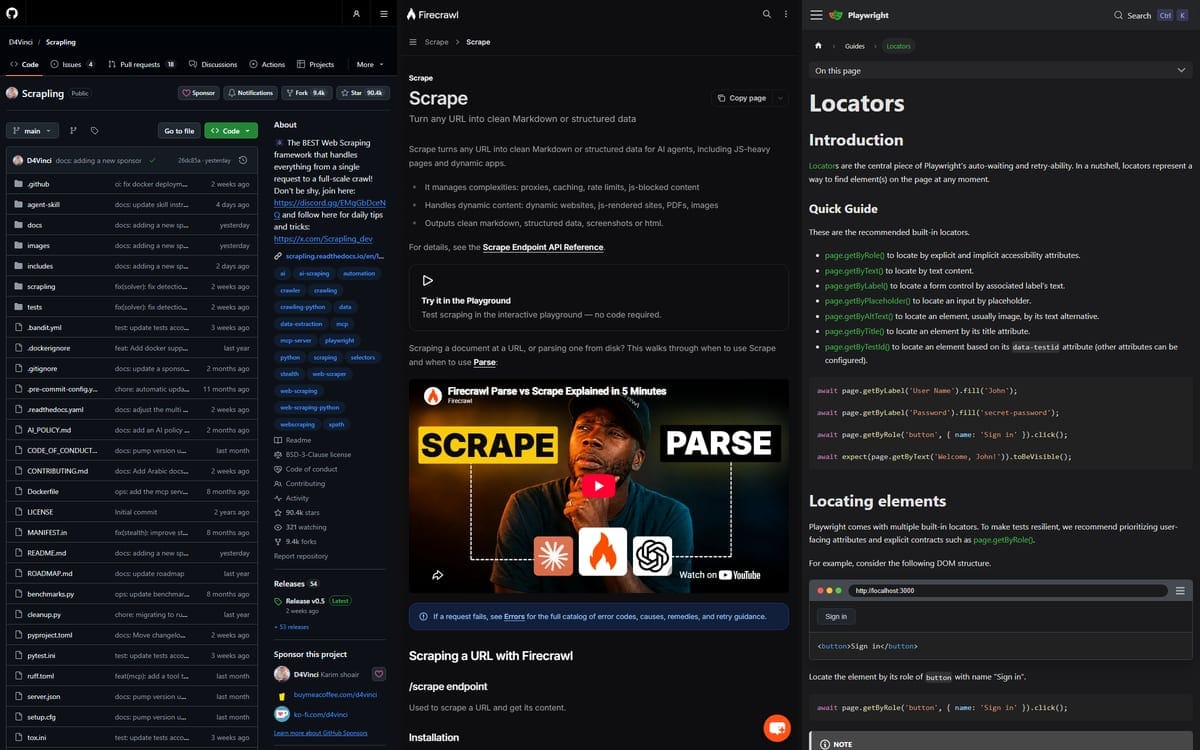
Scrapling vs Firecrawl vs Playwright: the short answer
The deciding question is which part of your pipeline you want to own. Scrapling combines Python parsing and fetching. Firecrawl packages extraction behind a managed API. Playwright provides browser control; you design the document extraction. This is a documentation-based comparison and suggested test protocol, not a hands-on speed benchmark.
| Need | First option to evaluate | What you still own |
|---|---|---|
| Python fields, CSS/XPath selectors and a crawler you operate | Scrapling | Selection rules, deployment, permitted access and output validation |
| Managed Markdown or HTML for an ingestion service | Firecrawl hosted API | Output acceptance, credit budget, freshness and data-handling checks |
| Exact clicks, navigation and browser-session control | Playwright | Extraction, browser infrastructure and protected session state |
| Lowest cost for your workload | Run the acceptance protocol below | Compute, retries, optional proxies, API charges and maintenance |
Scrapling vs Firecrawl: extraction control or managed output?
Scrapling documents HTTP and browser-backed fetchers, adaptive element relocation, crawling and Markdown export. Its CSS and XPath selectors let a Python pipeline target specific fields. Firecrawl documents Markdown and HTML output through its scrape API. Compare both against your output contract; neither a framework nor a managed service removes the need to inspect missing sections.
Try an original extraction fixture before a live site
Use our fictional pricing fixture and expected fields to test whether your extraction keeps plan names, billing periods, currency and row context together. The page is original practice material with no personal data or access barrier. Ask each workflow for the same fields and compare against the expected JSON. This isolates basic extraction correctness; it does not benchmark protected pages, real-world reliability or either service’s latency.
- Extract the table identified as plans, including its headings.
- Keep monthly price and included-page units separate.
- Treat missing fields as failures instead of filling them from a model guess.
- Record the exact request, cache mode and returned fields before comparing cost.
Scrapling vs Playwright: the layers overlap
Scrapling's DynamicFetcher supports browser-backed loading using Playwright's Chromium or Chrome. Playwright exposes locators for browser interactions. They are therefore not mutually exclusive choices. Evaluate Scrapling when parsing and crawling are the main job; evaluate direct Playwright when the interaction sequence is the difficult part. This is an architectural recommendation, not a measured ranking.
Firecrawl vs Playwright: avoid the false browser-or-no-browser split
Firecrawl also documents actions and richer interactive workflows. Playwright remains useful when you need direct control over the browser. Hosted Firecrawl and its self-hosted project are different deployment options; evaluate the features and operational requirements of the option you will actually use. Do not send sensitive session state to a third party by default.
What actually costs money?
A locally operated pipeline has compute, bandwidth, maintenance and potentially proxy costs, even without a per-page service charge. A hosted API has its own usage rules. Firecrawl documents credit charges and warns that cached results still consume a credit; optional formats and parsing can add charges. Compare total cost per accepted document, not price per attempted request. We have not established a cheaper winner.
| Cost item | Record in your trial | Why it matters |
|---|---|---|
| Service usage | Actual credits and billing unit | Different options can consume different amounts |
| Local infrastructure | Runtime, peak memory and hosting estimate | Open-source code is not free infrastructure |
| Retries and cleanup | Failed attempts and review minutes | Successful HTTP requests can still yield unusable text |
| Accepted-document cost | Total attributable cost / accepted documents | If accepted count is zero, cost per accepted document is undefined |
A reproducible RAG extraction protocol
This is our proposed worksheet. No Scrapling, Firecrawl or Playwright executions, paid API requests or hardware measurements were performed for this comparison. The separate HTTP check below is narrower. Start with ten pages you own or are permitted to process: five static articles, three JavaScript-rendered pages and two pages with important tables. Keep authenticated pages in a separate, authorized test. Preserve the same expected content and evaluation rules for every tool.
- Create a manifest with URL, page type, required headings, expected table cells, expected links and capture date.
- Pin package/API versions and record mode, browser version, concurrency, retry limit, timeout, location, language and cache settings.
- Before running, define acceptance: required text present, table relationships preserved, no error page, usable source URL and timestamp.
- Repeat each permitted page three times; distinguish first-run, fresh-fetch and cached results. Do not compare unlike cache modes.
- Record elapsed time, failures, missing fields, retries, output size and human cleanup minutes. Measure local peak memory only where you have actual instrumentation.
- Report accepted / attempted documents by page type; report median latency and range alongside sample size.
- Keep raw outputs for reproducibility where permitted. Redact credentials and sensitive content before sharing.
- Publish failed examples and limits. A small sample does not establish universal performance or access success.
Original evidence: a basic check on our own pages
On 10 October 2026 we ran a sequential Node.js v22.16.0 HTTP check on ten of our own non-news articles, three requests per page. All 30 responses passed five HTML checks: HTTP 200, a nonempty title, the expected canonical URL, one H1 and the source URLs listed in our catalog. This confirms those markers were present in returned HTML, not that extraction, citations or article claims are correct. Elapsed time covers request start through complete decoded HTML and includes connection and network effects. The no-cache request header does not guarantee an uncached CDN or origin response. This is not a Scrapling/Firecrawl/Playwright ranking, browser rendering test, Core Web Vitals result or GPU benchmark. Network location was not recorded. Raw runs and methodology ↗ and reusable Node script ↗ are public.
| Owned article | HTML checks passed | Median / range (ms, 3 requests) |
|---|---|---|
| Video tool comparison | 3/3 | 465.2 / 116.9–956 |
| FLUX workflow | 3/3 | 117.4 / 100–345.4 |
| Workstation build guide | 3/3 | 100.2 / 81.9–378.6 |
| SDXL comparison | 3/3 | 77.8 / 72.9–674.9 |
| Model switching checklist | 3/3 | 168.1 / 89.3–333.7 |
| Vector database comparison | 3/3 | 83.2 / 78.1–368.4 |
| Scraping comparison | 3/3 | 403.8 / 77.1–468.8 |
| Coding tool comparison | 3/3 | 99.2 / 79.5–476.1 |
| Notion decision log | 3/3 | 89.6 / 86.2–363.6 |
| Data enrichment comparison | 3/3 | 89.1 / 69.6–414 |
Preserve citations and reject misleading success
Firecrawl separates API success from the target page's metadata.statusCode and documents cache controls. Check both outcome and source freshness. For every accepted document, retain final URL, title, retrieval time and section identifier. Keep tables with their surrounding headings. Verify that a heading fragment really exists before constructing a source link. Choose chunk boundaries from document structure and evaluate retrieval separately; 400–600 tokens is not a universal optimum.
Wait for the content you need, not every network request
Playwright recommends locators and discourages waitForSelector and networkidle as general readiness shortcuts. Wait for a specific required element with a locator and check its content. A visible main container can still be empty. Preserve authenticated state only when necessary: storage-state files can contain credentials capable of impersonating the user and should not be committed to a repository.
Next: evaluate retrieval after extraction
Once the expected source material survives extraction, compare retrieval independently using our vector database evaluation guide. If you are building an answering workflow, distinguish retrieval from orchestration in the agents vs RAG guide. Better extraction helps preserve evidence; it does not guarantee accurate generated answers.
Follow the workflow from source capture to a reviewed answer
Extraction is the first decision. After preserving permitted source material, use the vector database comparison to plan retrieval evaluation, then the agents versus RAG guide to decide whether orchestration is necessary. Keep each stage's acceptance checks separate: a successful download does not prove correct retrieval, and a retrieved passage does not prove a correct generated answer.
Frequently asked questions
Is Scrapling better than Firecrawl?
There is no universal winner. Evaluate Scrapling for a Python pipeline you operate and Firecrawl for managed document output. Use identical permitted pages, required fields, cache modes and acceptance criteria before comparing cost or reliability.
Does Scrapling replace Playwright?
Not necessarily. Scrapling documents browser-backed fetching through DynamicFetcher using Playwright's Chromium or Chrome. Direct Playwright is useful when custom browser interactions are the main requirement; Scrapling adds a scraping-oriented workflow.
Is Playwright free to run for scraping?
A local workflow avoids a hosted per-page extraction charge, but compute, bandwidth, optional proxies and maintenance still cost resources. Compare attributable cost per accepted document rather than assuming a free library means free operation.
Can Firecrawl handle JavaScript pages and browser actions?
Its documentation includes browser actions and richer interactive workflows. Supported behavior should be checked for the API or self-hosted deployment you use. No tool guarantees access to every page or permission to process its content.
Which option is best for RAG citations?
Choose the workflow that preserves the source URL, headings, table context and retrieval timestamp on your evaluation pages. Validate real heading anchors and source status. Markdown output alone does not guarantee complete or verifiable citations.
Sources & further reading
Primary sources checked Oct 26, 2026. Vendor statements are attributed; editorial advice is our own.
- 1
- 2
- 3
- 4Playwright locators ↗Microsoft
- 5
- 6
- 7
Help us keep this useful. Report a factual correction →