What changed: RTX Spark laptops have launched
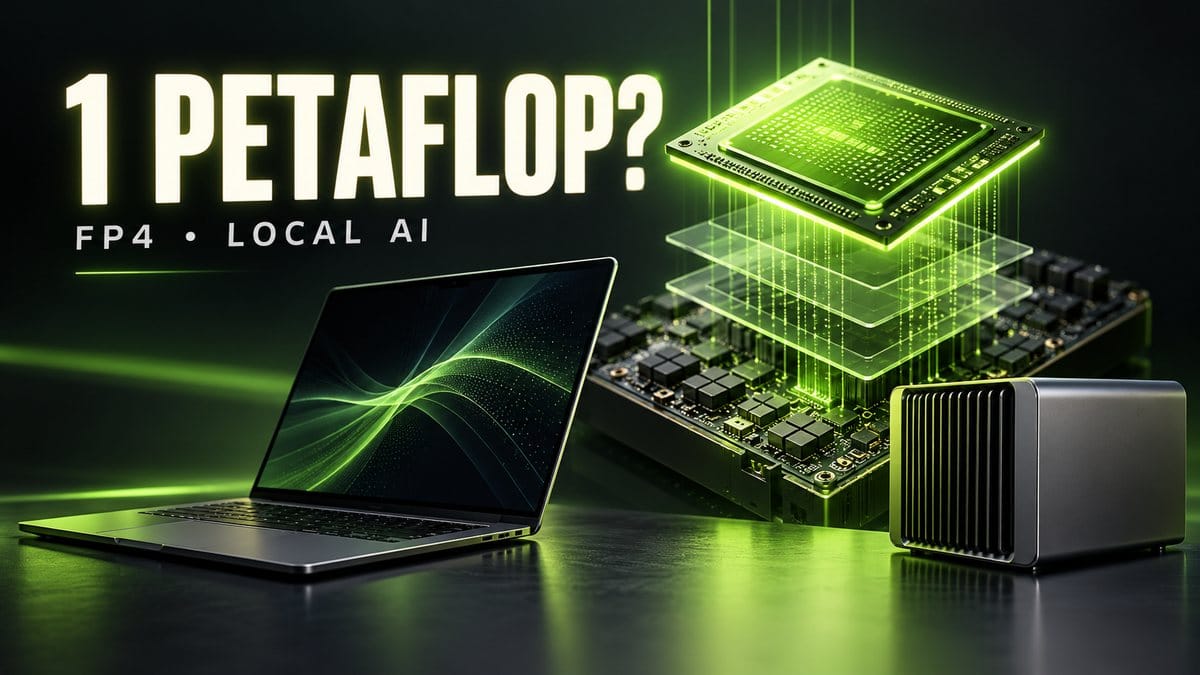
Our earlier version described a pending launch. NVIDIA's October 16 release now announces laptop availability through ASUS, Dell, HP, Lenovo, Microsoft and MSI, with more systems to follow. It advertises up to 128GB unified memory and up to one petaflop of FP4 AI compute. Those are vendor platform claims, not specifications guaranteed on every retail configuration. Check regional stock, memory, storage, warranty and delivery date on the device you can actually order. We have not tested a retail RTX Spark system.
What does one petaflop mean for local AI?
A petaflop denotes one quadrillion floating-point operations per second. Here, the precision qualifier matters: NVIDIA specifies FP4, not a universal rate for every numeric format or application. Do not convert the headline directly into language-model tokens per second, image generation time or a guaranteed speedup over your current GPU. Our buying rule is to treat peak compute as a specification to investigate, then ask for a repeatable run of the workload you need.
| Headline | What to verify | What it cannot establish alone |
|---|---|---|
| Up to 1 petaflop FP4 | Precision and conditions of the published rating | Your application's sustained throughput |
| Up to 128GB unified memory | Memory installed in the exact system | Available memory after all allocations |
| Local AI support | Model, runtime and dependency compatibility | Every plugin or extension will run |
| Portable computer | Workload-specific power and noise measurements | Battery life under your inference load |
RTX Spark vs DGX Spark: distinguish the systems
RTX Spark targets Windows PCs, including laptops. NVIDIA positions DGX Spark as a compact local AI desktop built on the GB10 Grace Blackwell platform. Its product page lists 64GB or 128GB unified memory options, with 64GB supplied through participating OEMs. These product families should not be collapsed into one buying recommendation because a compute headline looks similar. Confirm operating environment, hardware interfaces and supported software for the actual machine.
| Decision | RTX Spark | DGX Spark |
|---|---|---|
| Form factor to investigate | Partner Windows laptops and PCs | Compact desktop AI system |
| Memory claim | Up to 128GB; check retail configuration | 64GB or 128GB options on the current product page |
| Main practical check | Your Windows apps and portable workflow | Your desktop inference/development stack |
| Fair comparison | Same model, precision, context and task | Same model, precision, context and task |
Memory fit and speed require separate evidence
Suppose a model file fits within advertised system memory. That still leaves runtime buffers, context, encoders, the operating system and concurrent applications. Start with a complete workload specification rather than parameter count alone. The unified memory versus VRAM guide explains the capacity distinction; the RTX 4050 setup guide provides a smaller-system baseline. Neither guide establishes a measured Spark comparison.
Request this test before spending
Our proposed evaluation uses one everyday task and one demanding task you genuinely expect to run. Save exact inputs, expected output and acceptance rules. Ask for cold-load time and repeated warm-run time separately. If comparing systems, preserve model revision, precision and context instead of accepting a smaller model as equivalent. A fast wrong answer or damaged image is not a successful trial.
- Record system model, installed memory, OS, driver and runtime.
- Confirm required compiled extensions and plugins work.
- Use identical inputs and output requirements on alternatives.
- Record failures, peak memory where measurable and correction time.
- Check sustained behavior rather than one short demonstration.
- Check power and battery use under the intended workload if portability matters.
Does buying a new AI PC save money?
Compare the complete local purchase with your actual hosted usage. Include electricity, storage, maintenance, failed outputs and time spent keeping software working. If current hardware already completes acceptable work, a launch is not itself a reason to replace it. Use our local versus cloud cost worksheet and workstation purchase checklist. We provide no verified retailer quote or universal payback period.
What remains unverified
This article explains current vendor announcements and a buying method. It contains no independent Spark tokens-per-second result, battery measurement or image-generation timing. Public peak specifications cannot fill those evidence gaps. Keep results tied to the exact hardware, software and workload that produced them. This update preserves the original article URL and replaces stale pre-launch wording.
Frequently asked questions
Are NVIDIA RTX Spark laptops available?
NVIDIA announced availability on October 16, 2026. Check your country, retailer and exact configuration; the announcement does not guarantee local stock.
What does NVIDIA's one-petaflop claim mean?
It is an up-to FP4 AI compute rating. It does not directly tell you language-model tokens per second, image generation time or sustained application performance.
Are RTX Spark and DGX Spark the same product?
No. RTX Spark targets Windows PCs including laptops; DGX Spark is a separate compact GB10 desktop AI platform. Compare the exact system and software environment.
Does 128GB unified memory guarantee that a model runs?
No. Installed capacity, runtime support and full workload allocations must all be checked. Model-file size alone is insufficient.
Has FyreLinkz benchmarked these systems?
No. This article attributes specifications to NVIDIA and provides a proposed evaluation checklist; it is not a hands-on review.
Sources & further reading
Primary sources checked Oct 21, 2026. Vendor statements are attributed; editorial advice is our own.
- 1RTX Spark PCs available: October 16 announcement ↗NVIDIA · Oct 16, 2026
- 2
- 3
Help us keep this useful. Report a factual correction →